About

Transforming How Companies Support Their Workforce

The future of work is not an idea. It is the ability to meet employee needs in real time and invest with clarity. Inclusively brings together employee signals, AI-driven intelligence, and a unified framework so companies can support their people, reduce waste, and drive measurable ROI.

Illustration showing several pac people depicting the Inclusively team

Inclusively’s Origin

L

How It Started

Inclusively started as a hiring platform for people with disabilities, using AI to help job seekers identify what Success Enablers are needed to be successful in a role and enabling companies to find qualified talent that was historically screened out. 

L

How It’s Going

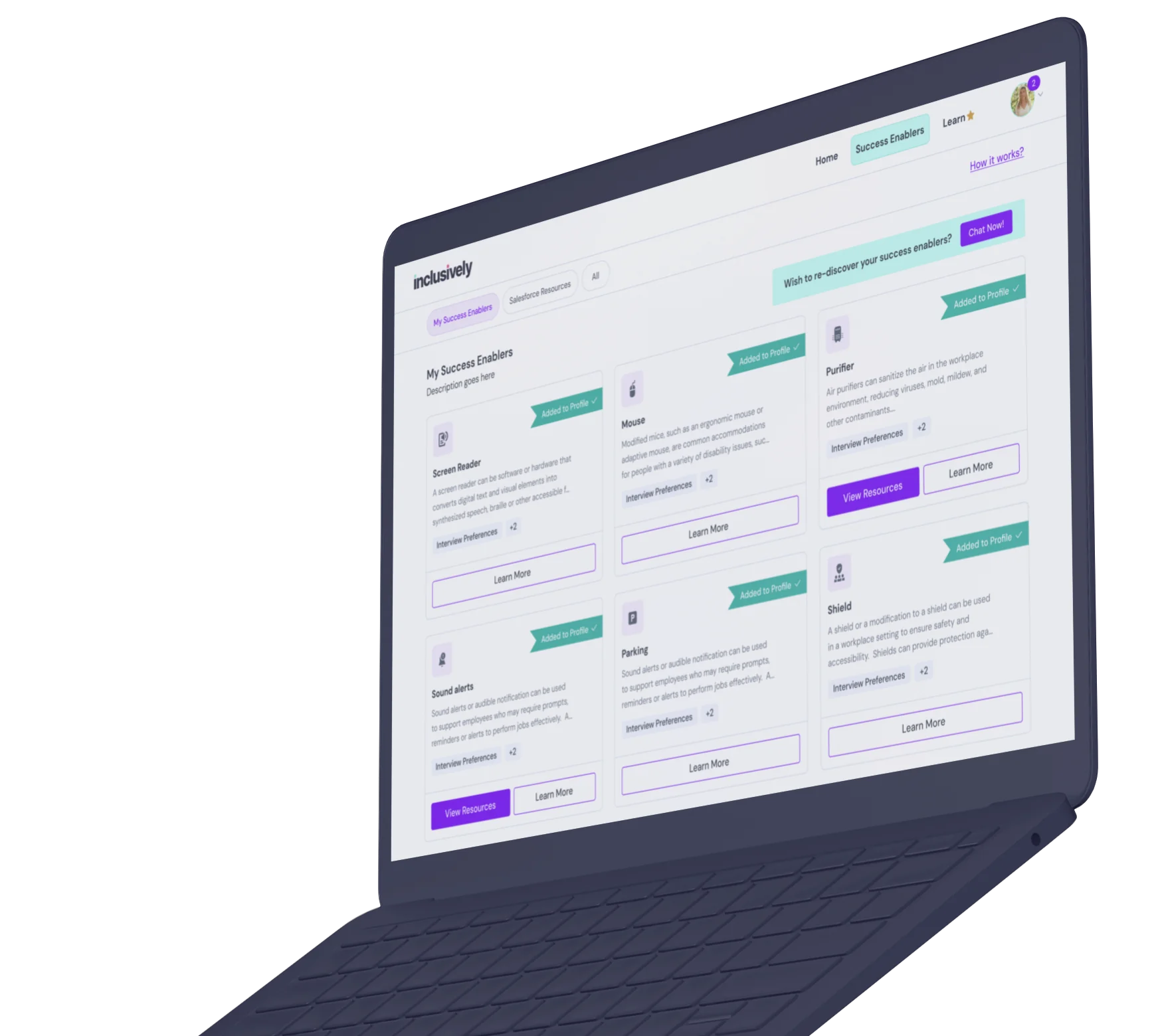
We have expanded our technology to meet the growing demand for personalization, access, and clarity in the workplace. Our Retain platform was built to address a simple truth. Employees are not struggling from a lack of benefits. They are struggling because support is hard to find, scattered across systems, and disconnected from their real needs.

Retain gives companies a real time understanding of what employees are searching for and connects those needs to the Success Enablers already in place. Employees can quickly discover the resources that help them stay productive and supported. Employers gain live visibility into workforce needs, underutilized programs, and opportunities to reduce costs and strengthen outcomes.

The Workforce Has Changed.
HR Data Has Not.

Employees are not struggling because employers lack benefits. They are struggling because support is scattered, confusing, and hidden inside too many systems. Leaders cannot see what is used, what is wasted, or where investments drive impact.

Retain exists to fix that.

We help companies understand real employee needs in real time, align their offerings to actual demand, and prove the value of their investments.

Better access for employees. Better ROI for employers.

R

Personalization is no longer a nice-to-have

Younger generations were diagnosed earlier than preceding generations and are accustomed to requesting personalized education plans to accommodate for learning disabilities and mental health conditions. These individuals are entering the workplace advocating for similar support in their professional lives. 

Post-COVID expectations span generations

The pandemic broadened access to remote and flexible work possibilities for all working generations. In COVID’s aftermath, employers face changing infrastructure needs and increasing mental health issues in the workforce. There is increasing pressure on employers to provide more flexibility and support for employees than ever before.

Presenteeism is not a cost you can afford

There is a cost associated with underproductive employees, whether due to disability (including chronic illness or mental illness) or because they provide care for a loved one. More than half of a company’s employees fall into these categories and have unmet needs. Let’s fix this.

Retain Solves the Problems Today’s Enterprises Cannot Ignore

L

Increase utilization of underused programs
Connect employees to the resources you already offer and reduce wasted spend.

L

Contain rising costs
Identify hidden drivers of medical claims, absenteeism, and turnover in real time.

L

Prove the value of every investment
Make decisions with evidence, not assumptions.

L

Reduce operational burden
Automate mapping, maintenance, and repetitive employee requests.

L

Improve employee experience at scale
Give every employee clear, private access to support when they need it.

People are now realizing that you can't just muscle things back to how they were before the pandemic. We have a new generation entering the workforce that was diagnosed earlier than any generation that preceded them with learning disabilities and mental health conditions. This generation has requested personalized education plans that accommodated their needs and are placing the same demands on their employers as they start their careers.
Sarah Bernard, co-founder and COO of Inclusively
People are now realizing that you can't just muscle things back to how they were before the pandemic. We have a new generation entering the workforce that was diagnosed earlier than any generation that preceded them with learning disabilities and mental health conditions. This generation has requested personalized education plans that accommodated their needs and are placing the same demands on their employers as they start their careers.
Sarah Bernard, co-founder and COO of Inclusively - Premium Guide
Sarah Bernard, co-founder and COO of Inclusively
You can have your cake and eat it too. You can create flexibility that actually leads to increased productivity and retention. It's not an either/or situation. You’re not opening the floodgates or a can of worms that you can’t control. Instead, you can put guardrails around this process, rather than letting it become chaotic and unmanageable.
Christina Mallon, Head of Inclusive Design at Microsoft
You can have your cake and eat it too. You can create flexibility that actually leads to increased productivity and retention. It's not an either/or situation. You’re not opening the floodgates or a can of worms that you can’t control. Instead, you can put guardrails around this process, rather than letting it become chaotic and unmanageable.
Christina Mallon, Head of Inclusive Design at Microsoft - Premium Guide
Christina Mallon, Head of Inclusive Design at Microsoft
We need flexibility for women in the middle layers of a company. These are the people who have the institutional knowledge of how things work; they've been here for a significant amount of time. They are in the prime of their careers but also starting families. We don’t want to lose them. If they had more flexibility, retaining them would be much easier. We’ve done a good job in building programs for this, but many other organizations are still struggling.
Judy Miller, Chief of Staff for Jamie Dimon at JP Morgan
We need flexibility for women in the middle layers of a company. These are the people who have the institutional knowledge of how things work; they've been here for a significant amount of time. They are in the prime of their careers but also starting families. We don’t want to lose them. If they had more flexibility, retaining them would be much easier. We’ve done a good job in building programs for this, but many other organizations are still struggling.
Judy Miller, Chief of Staff for Jamie Dimon at JP Morgan - Premium Guide
Judy Miller, Chief of Staff for Jamie Dimon at JP Morgan
People have been able to personalize almost every aspect of their lives. Everything is tailored, everything has an algorithm. The pandemic really provided the first opportunity to personalize work for a lot of people. Now, people want to tailor how they work. As long as it makes them productive and makes them more likely to stay — and doesn’t create an extra layer of administrative tasks for their managers — it’s a win.
Jon Singel, VP, Talent Acquisition at Lyft
People have been able to personalize almost every aspect of their lives. Everything is tailored, everything has an algorithm. The pandemic really provided the first opportunity to personalize work for a lot of people. Now, people want to tailor how they work. As long as it makes them productive and makes them more likely to stay — and doesn’t create an extra layer of administrative tasks for their managers — it’s a win.
Jon Singel, VP, Talent Acquisition at Lyft - Premium Guide
Jon Singel, VP, Talent Acquisition at Lyft

Ready to unlock real ROI from your workforce investments?